
What you'll learn
Discover the practical skills of hand tools in this hands-on woodworking course in Sydney.
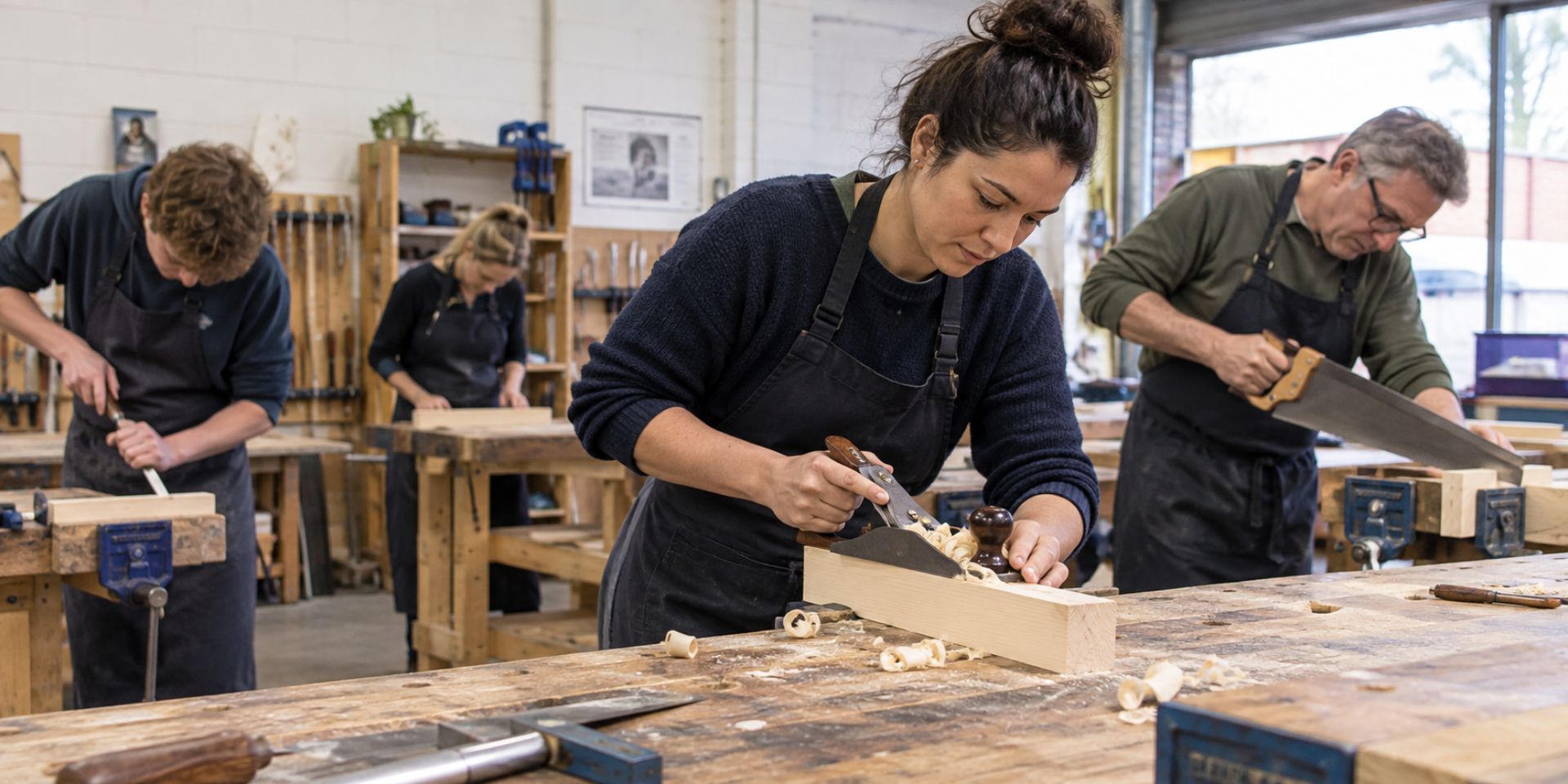
Get hands-on with traditional woodworking hand tools in this practical introduction to chisels, hand planes and saws. Designed for beginners and those looking to build their confidence with basic woodworking tools, this workshop focuses on learning by doing.
You’ll spend the session working directly with timber, learning how to safely set up your work area, hold and control your tools, read the grain of the timber and develop accurate cutting and shaping techniques. Through a series of guided exercises, you’ll gradually build your skills before bringing them together in a combined timber exercise.
The workshop covers three essential hand-tool skills: sawing, chiselling and planing, along with basic sharpening and tool maintenance. Your tutor will demonstrate each technique before you have the opportunity to practise it yourself, with guidance and feedback throughout the session.
Learning Outcomes
By the end of the workshop, participants should be able to:
- Safely set up and secure timber for hand-tool work.
- Use common hand saws, chisels and planes with correct technique.
- Understand grain direction and how it affects cutting and planing.
- Make basic straight cuts, recesses and shaped/finished edges.
- Recognise when a tool is blunt or poorly adjusted.
- Carry out basic sharpening and maintenance of chisels and plane irons.
1. Workshop Safety & Work holding
Brief introduction followed immediately by practical setup.
Participants practise:
- Correctly positioning timber in a vice.
- Using clamps and bench hooks.
- Checking that timber is secure before starting work.
- Safe stance and body positioning.
- Keeping hands and fingers outside the cutting path.
- Inspecting tools before use.
- Safe handling and placement of sharp tools on the bench.
The emphasis is on establishing good habits that are then reinforced throughout the workshop.
2. Handsaw Practice
Short facilitator demonstration covering:
- Different common saws and when to use them.
- Cross-cut versus rip-cut.
- Correct grip and stance.
- Starting a cut with light, controlled strokes.
- Following a marked line.
- Using the full length of the saw.
- Allowing the saw to cut rather than forcing it.
- Supporting the offcuts correctly.
Participants then practise on timber:
- Marking a square cut.
- Starting a saw cut accurately.
- Cutting timber to length.
- Cutting to the waste side of a marked line.
- Producing a reasonably square cut.
- Repeating cuts to improve accuracy and control.
Facilitator circulates and corrects grip, stance, work-holding and hand position.
3. Chisel Practice
Short demonstration covering:
- Chisel anatomy and cutting edge.
- Correct grip.
- Working with and across the grain.
- Paring versus using a mallet.
- Removing small amounts of material at a time.
- Keeping both hands behind the cutting edge.
Participants practise:
- Paring timber to a marked line.
- Removing small amounts of timber.
- Cutting a simple notch or housing.
- Chiselling across the grain.
- Cleaning up the bottom and edges of a recess.
- Using a mallet safely and with control.
Participants can use their earlier saw cuts to form part of the chisel exercise, helping connect the different tools.
4. Hand Plane Practice
Short demonstration covering:
- Basic parts of a hand plane.
- Checking and adjusting the blade.
- Setting a light cutting depth.
- Correct grip and stance.
- Identifying grain direction.
- Pressure at the beginning, middle and end of a stroke.
Participants practise:
- Setting up and testing a plane.
- Producing a fine shaving.
- Planing a rough or sawn edge.
- Planing timber with the grain.
- Straightening and smoothing an edge.
- Creating a small chamfer.
- Adjusting the plane when it is cutting too heavily or unevenly.
The aim is for participants to feel the difference between a correctly adjusted plane and one that is poorly set.
5. Sharpening & Tool Maintenance
This section remains practical rather than lecture-based.
Facilitator demonstrates:
- Identifying a blunt edge.
- Sharpening stone or diamond plate setup.
- Basic bevel angle.
- Using a honing guide.
- Raising and removing a burr.
- Honing the cutting edge.
Participants practise:
- Setting a chisel or plane iron in a honing guide.
- Sharpening/honing the bevel.
- Removing the burr.
- Checking the finished edge.
- Returning the blade to the tool and testing it on timber.
Where possible, participants compare the tool's performance before and after sharpening.
Basic maintenance is incorporated during the exercise:
- Cleaning tools.
- Protecting cutting edges.
- Checking handles and components.
- Preventing rust.
- Correct storage.
6. Combined Skills Exercise
Participants complete a simple timber exercise using all three tool groups.
For example:
- Measure and mark a piece of timber.
- Saw it accurately to length.
- Saw the sides of a notch.
- Chisel out the waste.
- Clean up the joint with a chisel.
- Plane an edge smooth and straight.
- Add a small chamfer to the finished piece.
The finished object is less important than practising accuracy, control and safe technique.
Workshop Finish
Group clean-up followed by a quick recap:
- Correct saw technique.
- Safe chisel hand position.
- How to recognise grain direction.
- Correct plane setup.
- Signs that a cutting edge needs sharpening.
- How to safely store and maintain the tools.
Intended audience
Who is this workshop for?
- This course is for complete beginners who have had no experience with woodwork.
Course venue
Where is the workshop located?
- Workshops are held at the Summer Hill campus. You'll receive full venue details when you enrol.
Course materials
-
What to bring to class
-
Any drills or tools from home you would like to use
-
The following PPE:
- A face mask
- Safety glasses or googles
- Earmuffs or earplugs
Additional information
- Please note the following:
- Please don't wear your best clothing
- If you have long hair, please tie it back
- Wear closed-in shoes, no heels, please
- Please do not wear jewellery
- Content may vary slightly depending on class pace, participant interests, and instructor approach.
Course tutors

The Bower
Great reasons to enrol in a short course with us
Small classes
A personal approach means quality learning, so you can enjoy plenty of interaction with your instructor and the chance to ask questions.
Short & sweet
Our short courses & workshops get straight to the point, providing the skills you need with minimal commitment of your precious time.
Facilities & equipment
Our range of venues suit every type of course, are easy to get to, and have the equipment and tech needed to support your learning.
Easy, secure enrolment
Enrol online 24/7 with a safe, convenient 3-step process.
Quality instructors
Our educators bring first-hand experience and knowledge, with up-to-the-minute practices from diverse industries.
Business or pleasure
Our courses help you rapidly increase your skills and knowledge, for professional development or personal interest.
4.7 starsaverage rating on Google
1,400+courses to choose from
99%customer support rating
Classes Online Courses
<p>Discover the practical skills of hand tools in this hands-on <a href="https://www.sydneycommunitycollege.edu.au/courses/handcrafts/woodwork">woodworking course </a>in Sydney.</p>
<p>Get hands-on
...If there isn't a class to suit you, please join our waitlist and we will notify you when we have places available. Join waitlist for Introduction to Hand Tools
If there isn't a class to suit you, please join our waitlist and we will notify you when we have places available. Join waitlist for Introduction to Hand Tools